A balance without an explanation
Knowing how much a customer owes is not enough if administration has to reconstruct which movements make up that balance.
Metrify connects sales, payments, advances, credit notes, due dates and balances so you can answer how much a customer owes, why, and how healthy that credit really is.
That is why credit needs to follow the operation after the invoice instead of stopping at the amount sold.
Knowing how much a customer owes is not enough if administration has to reconstruct which movements make up that balance.
If sales still has to ask whether a payment arrived, the operation depends on human coordination.
The total outstanding amount can look stable while the oldest debt keeps growing.
A salesperson can place a lot of credit and still leave worse recovery. Both results need to be visible together.
From customer to movement
Metrify builds context around accounts receivable so a person can move from the total down to sales, payments and related movements.
Sales, payments, advances, credit notes, adjustments and due dates form the reading of the balance.
Collections and receivables can be read alongside sales and branches to understand the quality of the result.
The story of an account
Sale
What created the account receivable.
Movements
Payments, advances, notes and adjustments.
Time
Current, 1–30, 31–60 and 60+ days.
Result
Balance, overdue receivables and recovery.
Customer account
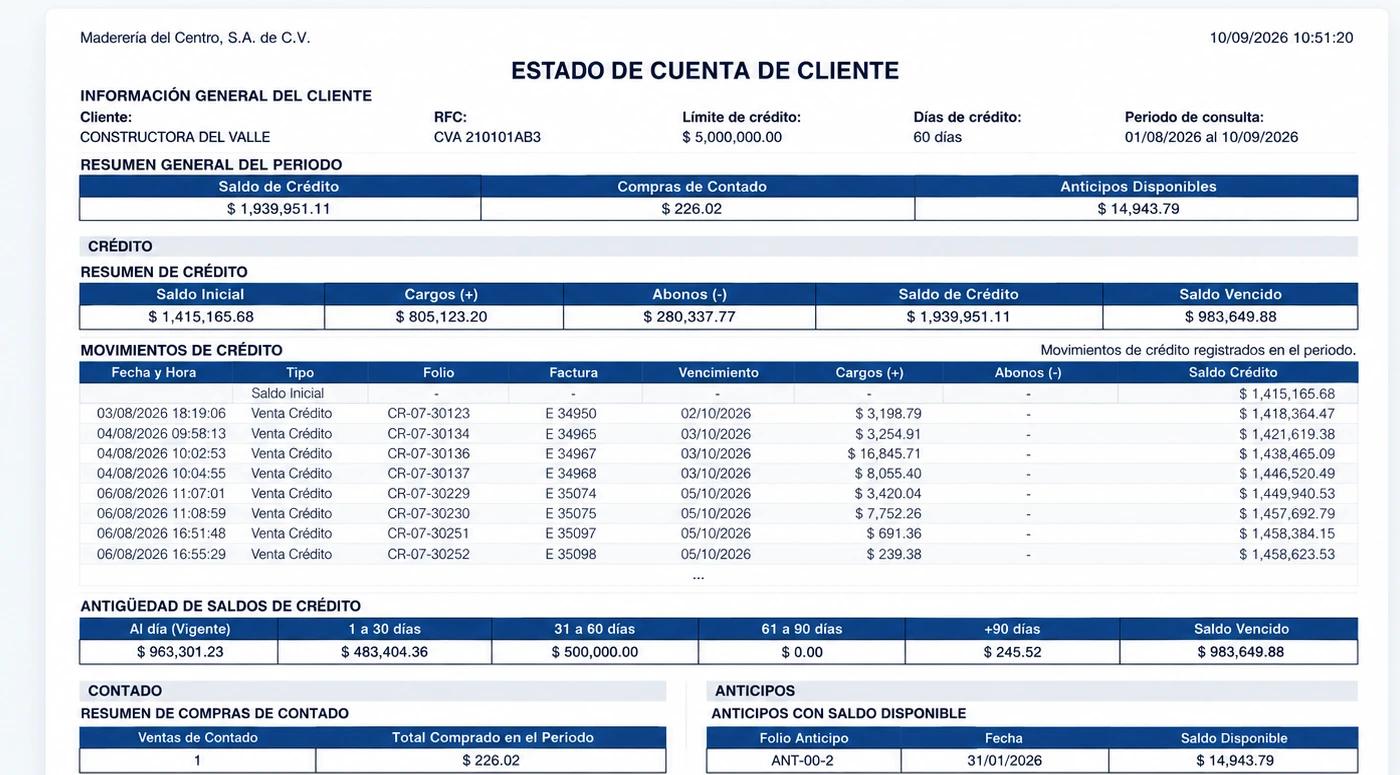
The balance stops being an isolated number. Metrify lets you trace it back to sales, payments, advances, credit notes and due dates that explain how it was formed.
Accounts receivable and collections
Time, recovery and the origin of the balance completely change what a receivables number means.
Outstanding does not always mean problematic. Overdue deserves a different reading.
Receivables are the money placed on credit that still needs to come back. Overdue receivables isolate the portion that has already passed its expected payment date so collections can focus where risk is increasing.
Metrify can analyze these balances by customer, salesperson or branch when that context is part of the operation.
Two million outstanding means something very different when one amount is due tomorrow and another has been stuck for months.
Breaking receivables into aging bands shows how far the money has moved from its expected recovery date. Time bands help distinguish healthy growth from accumulation of old debt.
For management, the 60+ trend can matter more than the total balance if it keeps growing month after month.
Money placed needs a second metric: how much came back.
Payments and other movements that reduce balances make it possible to measure recovery during the period. Comparing collections with the corresponding receivables helps show whether credit sales are actually turning into cash.
Seen next to sales, this metric prevents strong commercial performance from hiding weak recovery.
Sales + credit
That combination is exactly the kind of contradiction Metrify dashboards try to make visible before period-end turns it into a surprise.
The question changes from ‘how much did we sell?’ to ‘how well are those sales turning into money?’
How much was placed during the period.
How much money was actually recovered.
What portion has already passed its due date.
Where the oldest risk starts to concentrate.
Credit inside the ERP
Connect receivables with the rest of the operation.
Credit and collections
Credit
Combine placement and recovery instead of rewarding volume alone.
Credit
Current, 1–30, 31–60 and 60+ days represent different risks.
Credit
Why a balance should be able to explain where it came from.
For companies that need to know not only how much they sold on credit, but how much they are recovering.
Yes. Metrify connects credit sales, payments, advances, credit notes, due dates and other movements to build balances and account statements.
Yes. Dashboards can separate debt by due date and aging bands such as current, 1–30, 31–60 and 60+ days.
Yes. When the operation structure supports it, recovery can be analyzed by branch, salesperson, customer and period.
Yes. Metrify supports relationships where one payment can be distributed across multiple sales while preserving application context.
Bring the spreadsheet, exception or process that still depends on calls, memory or repeated data entry. Start there.