Stock that cannot explain the movement
‘There are 9’ does not explain why there should have been 12 or which operation changed the quantity.
Metrify connects the sale, the physical movement, the payment and the fiscal document so an inventory difference or balance can be reconstructed without starting from zero.
The problem appears when inventory, sales, payments and CFDI documents exist but live too far apart.
‘There are 9’ does not explain why there should have been 12 or which operation changed the quantity.
When the CFDI is detached from the sale, payment and return, administration ends up rebuilding relationships.
Sales, payments, advances, notes and adjustments should explain the balance instead of making people guess.
When a fiscal provider fails, retrying without context can create problems more expensive than the original interruption.
One story
Metrify preserves relationships between what was sold, what moved, what was paid and what was invoiced.
Movement, user, branch, date, origin and related operation.
CFDI, payment complement, credit note and cancellation tied to the operation that caused them.
Questions the system should answer
Why did stock change?
Go from balance to movement.
Which document came from this sale?
Follow the commercial ↔ fiscal relationship.
What makes up this balance?
Reconstruct it from movements.
Did this operation already happen?
Validate before trying it again.
Traceability
The history keeps item, date, branch, movement type and related operation so the reason behind a stock change can be reconstructed.
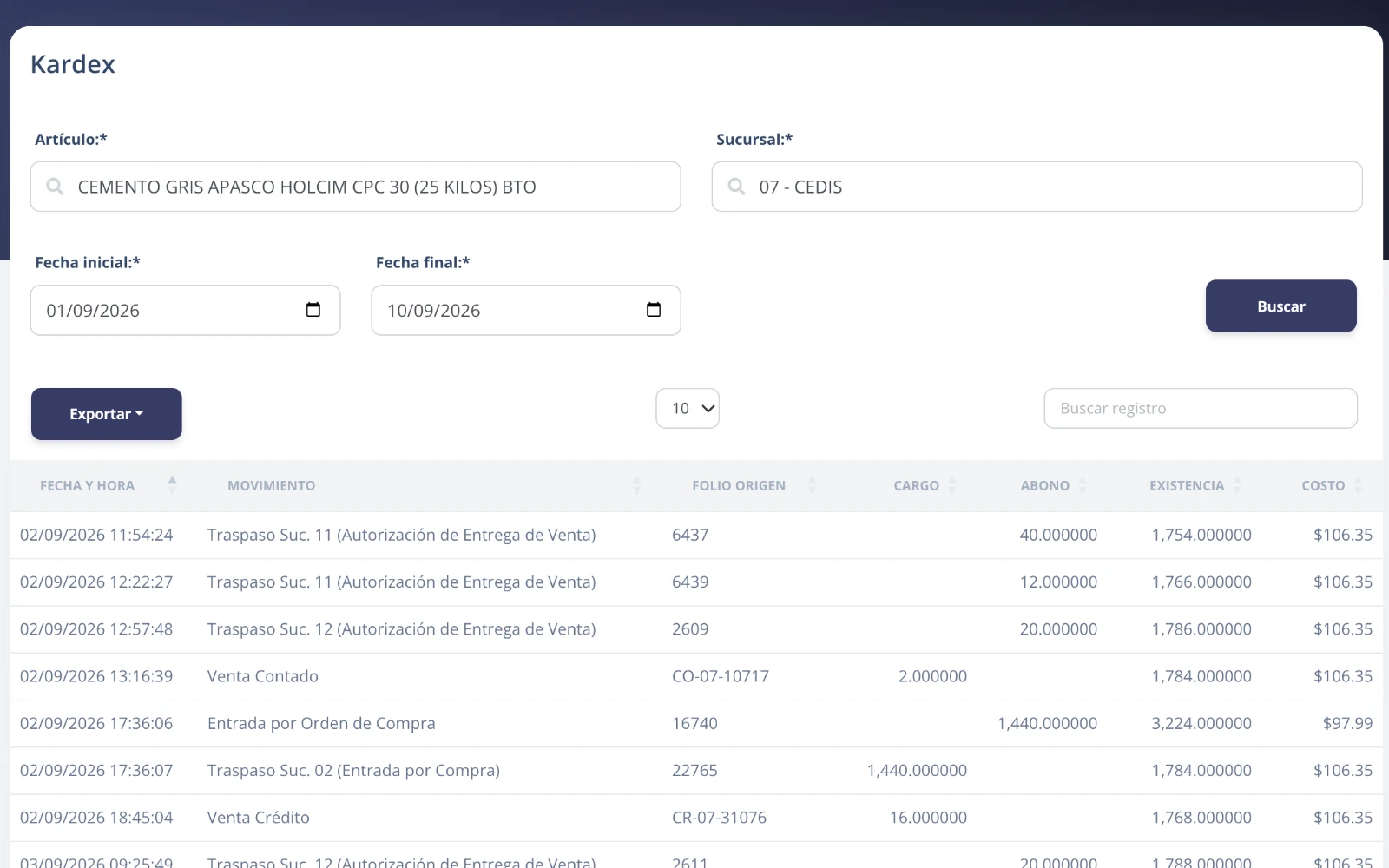
Connected inventory and invoicing
A useful architecture preserves those causes so sales, warehouse and administration can follow the same operation.
A correct number is useful. An explainable number is more useful.
Metrify records movement context to reconstruct stock changes: branch, user, date, operation type and available relationships with sales, purchases, adjustments or transfers.
This matters especially in multi-branch operations, where a difference may have started at another location and passed through several steps before becoming visible.
The invoice should not become an orphaned document.
A sale can originate an income CFDI; a payment may require a complement; a return may produce a credit note; an advance has its own fiscal flow. Metrify preserves those relationships so fiscal work is a consequence of the operation instead of a separate universe.
That connection also makes investigations easier when a PAC is intermittent or an operation needs validation before another stamping attempt.
A supplier invoice should not be entered twice.
For purchases with XML, Metrify can use the document as the starting point: drop, review and approve. Merchandise receiving no longer begins with item-by-item entry.
The gain is not only speed. Reducing re-entry also reduces differences between what arrived, what was recorded and what later appears in inventory.
Learned the hard way
Fiscal providers and payment terminals have had real intermittent failures. That pushed Metrify toward stronger audit, correlation, logs and validation before repeating operations.
Reliability is not assuming everything answers. It is preserving enough context when something does not.
Tie attempts and responses back to the internal operation.
Check before stamping or charging again.
Keep evidence for later investigation.
Continue without losing the history.
Connect the pieces
Continue with the problem that repeats most in your operation.
Traceability
Inventory
Walk through movements and context before correcting the number.
Purchasing
From entering a whole invoice to reviewing and approving it.
Credit
Sales, payments, advances and notes inside one story.
Common questions.
Yes. Metrify connects commercial operations, inventory movements and fiscal documents inside a web ERP for companies in Mexico.
Yes. Commercial operations can create inventory movements while preserving branch, user and origin context.
Yes. Commercial and fiscal operations are related for sales, payments, credit notes and other applicable flows.
Yes. Traceability aims to explain how current stock was reached through movements and operational context.
Bring the spreadsheet, exception or process that still depends on calls, memory or repeated data entry. Start there.