Do we have it here? What about another branch?
If real stock still depends on calling another location, inventory has not reached the counter yet.
Metrify was born inside a building-material distributor. That is why it connects counter sales, warehouse, purchasing, credit, invoicing and metrics around problems we have already lived through.
More items, salespeople, branches and credit turn small questions into hours of work spread across the company.
If real stock still depends on calling another location, inventory has not reached the counter yet.
Discounts, wholesale terms, credit and approvals should not depend on who remembers the rule best.
When something does not match, stock without history only starts a human investigation.
Sales, collections, receivables and categories can tell different stories about the same branch.
Born in this world
Metrify connects the sale with the customer, item, branch, inventory movement, fiscal document and result management will later see.
Sales can get what they need without leaving the customer to chase information.
Credit, discounts and approvals stop being oral knowledge.
What one sale can know
Product
line, group, stock and movement.
Customer
commercial terms, credit and balance.
Branch
context, inventory and approval.
Result
target, performance, collections and metrics.
Counter operation
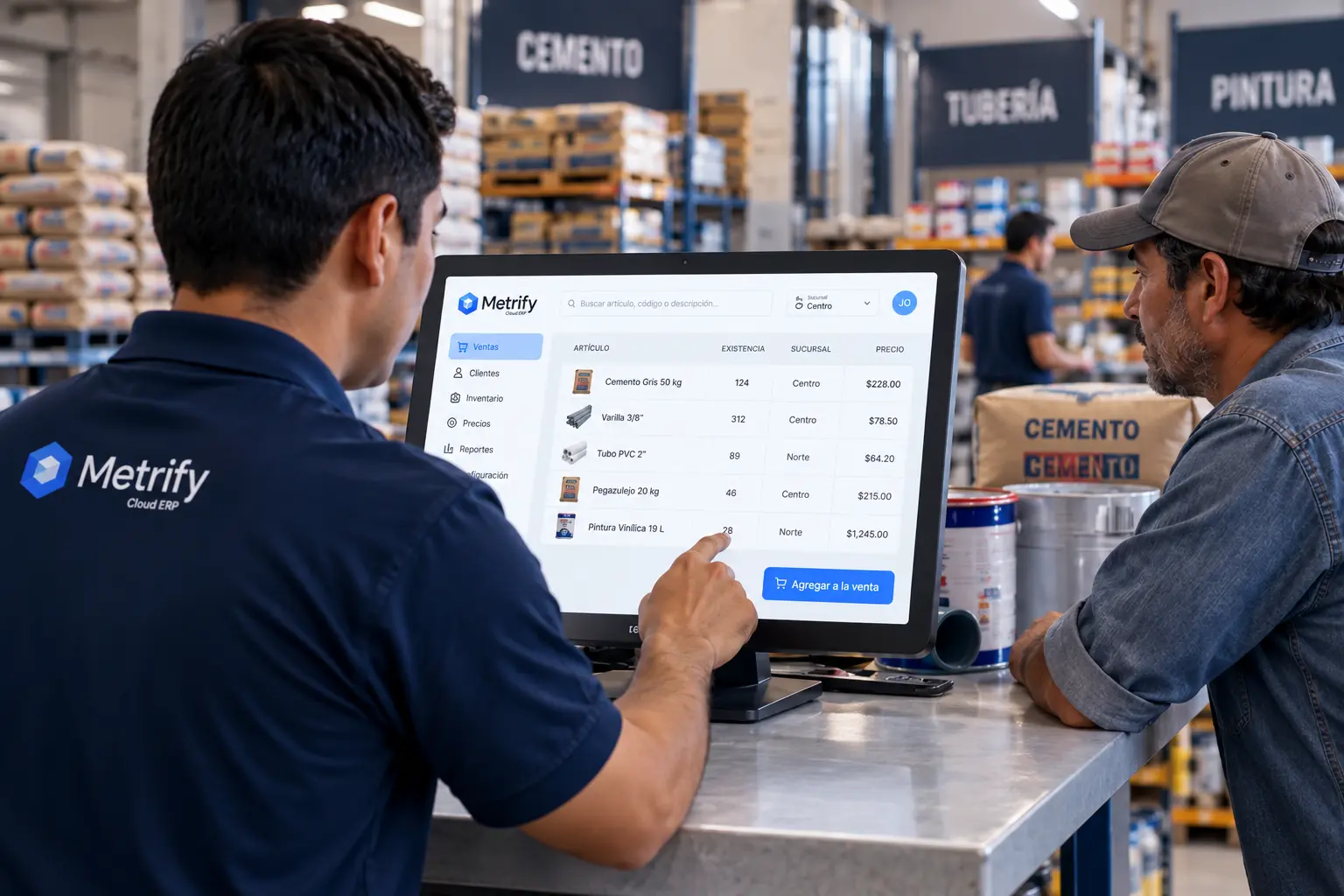
The salesperson checks stock, applies customer conditions and keeps the operation moving without separating the counter, warehouse and administration.
Software for hardware businesses that have already grown
An ERP for hardware stores needs to understand a high-volume operation with items, branches, credit, purchasing and counter sales without turning every exception into manual work.
Knowing stock is the beginning, not the end.
When you manage thousands of SKUs, an inventory difference affects sales, purchasing and trust between departments. Metrify keeps movements with user, branch, date, origin and related operation to help explain how stock reached its current quantity.
The same structure makes it possible to see inventory by branch without losing the distributor-wide view, especially when a salesperson needs to locate material while the customer is still in front of them.
A large invoice should not become an afternoon of data entry.
In the operation that gave rise to Metrify, recording purchases could mean taking a supplier invoice and entering items one by one before receiving them into inventory. With large documents, the process could consume hours.
Today a purchase can start from XML: drop the file, review the information and approve it. The point is not to show off automation; it is to remove re-entry and reduce the number of places where someone can make a mistake.
Selling a lot on credit and collecting poorly is not a healthy branch.
Metrify connects customers, commercial terms, sales, payments, advances, credit notes and due dates so the balance has an explanation. That makes it possible to read sales and recovery as parts of the same business.
For management, a branch can be above its commercial target and still deteriorate its receivables. That is why dashboards can combine attainment, collections, overdue receivables and aging instead of rewarding one number alone.
Where Metrify learned
Construalianza put the problems in front of us every day: branches, salespeople, inventory, credit, invoicing, purchasing and decisions that could not wait.
That is why many of the questions you have today have already left a scar in the product.
Different contexts over one connected operation.
Sales, administration, warehouse and management using the ERP.
From item-by-item entry to drop, review and approve.
Indicators that understand groups, lines, salespeople, targets and bonuses.
Go deeper
Follow the part of the operation that is taking the most time today.
Stock, movements, transfers and traceability across branches.
Ver más →Counter sales connected with customer, inventory, credit and invoicing.
Ver más →Targets, salespeople, categories, collections and receivables in a management-ready view.
Ver más →Guides for hardware businesses
Inventory, purchasing and point of sale explained from a building-material operation.
Point of sale
The sale does not end at the ticket when there are branches, credit and inventory.
Inventory
Stock by location, transfers and traceability.
Purchasing
How to remove hours of entry from large supplier invoices.
The questions that matter before moving the operation to another system.
Yes. Metrify was born inside a building-material distributor in Mexico and its strongest fit today is operations with inventory, branches, salespeople, credit and invoicing.
Yes. Each location can keep its own stock and movements without losing global visibility or origin traceability.
Yes. The sale can connect customer, inventory, payment and fiscal documents inside the same operation.
Yes. Metrify connects sales, payments, advances, credit notes, due dates and balances to view receivables and collections with context.
No. Its strongest fit today is distributors with similar complexity: large inventories, multiple branches, salespeople, credit and rules that cross departments.
Bring the spreadsheet, exception or process that still depends on calls, memory or repeated data entry. Start there.